There's a universal kitchen experience: you're mid-recipe, hands messy, and you open a drawer to grab a spatula — only to dig through a jumble of mystery gadgets, tangled measuring spoons, and at least three things you forgot you owned. Sound familiar?
The good news is that organizing your kitchen drawers isn't a weekend-long project. With the right approach and a few smart organizers, you can go from chaotic to completely functional in just a couple of hours. Here's exactly how to do it.
Step 1: Empty Everything Out First
Before you buy a single organizer or rearrange anything, pull everything out of every drawer and lay it all on your counter or kitchen table. All of it. Yes, even the junk drawer.
This step feels tedious, but it's essential. You can't properly organize what you can't see, and most people are genuinely surprised by what's been lurking in the back of their drawers for years.
As you empty each drawer, sort items into three piles:
- Keep — things you use regularly
- Donate or relocate — things that work but belong elsewhere in the house
- Toss — broken tools, expired coupons, single-use items you've never touched
Be ruthless here. Kitchen drawer clutter almost always comes from keeping things "just in case" rather than because you actually need them.
Step 2: Clean the Drawers Before Putting Anything Back
With the drawers empty, take two minutes to wipe them down. Crumbs, grease, and dust accumulate at the bottom of kitchen drawers over time. A damp cloth and a quick dry is all it takes. If your drawers have a paper or vinyl liner, now is a good time to replace it.
This is also a good moment to check if any drawer slides need tightening or lubricating — a smooth-gliding drawer makes a huge difference in daily kitchen life.
Step 3: Plan Your Drawer Zones
Not all drawers are created equal. Before you start putting things back, think about where each drawer sits in relation to how you cook:
Near the stove: This is prime real estate. Keep your most-used cooking tools here — spatulas, wooden spoons, tongs, ladles, and whisks. You want these within arm's reach when you're standing at the burners.
Near the sink or prep area: Peelers, can openers, kitchen scissors, and measuring cups and spoons work well here since you often need them during prep.
Near the dining area or table: Cutlery, serving utensils, and napkins belong in drawers closest to where you eat.
Away from the main work zone: Specialty tools you use occasionally — cake decorating tips, skewers, corn holders — can live in a less accessible drawer. You don't need them every day.
The goal is to reduce the number of steps you take while cooking. Everything you use daily should be reachable without moving from your main work area.
Step 4: Choose the Right Organizers
This is where most people go wrong — they buy organizers before they know what they're organizing. Now that you've sorted your items and planned your zones, you can choose organizers that actually fit.
Here are the main types and when to use each:
Bamboo Drawer Organizers
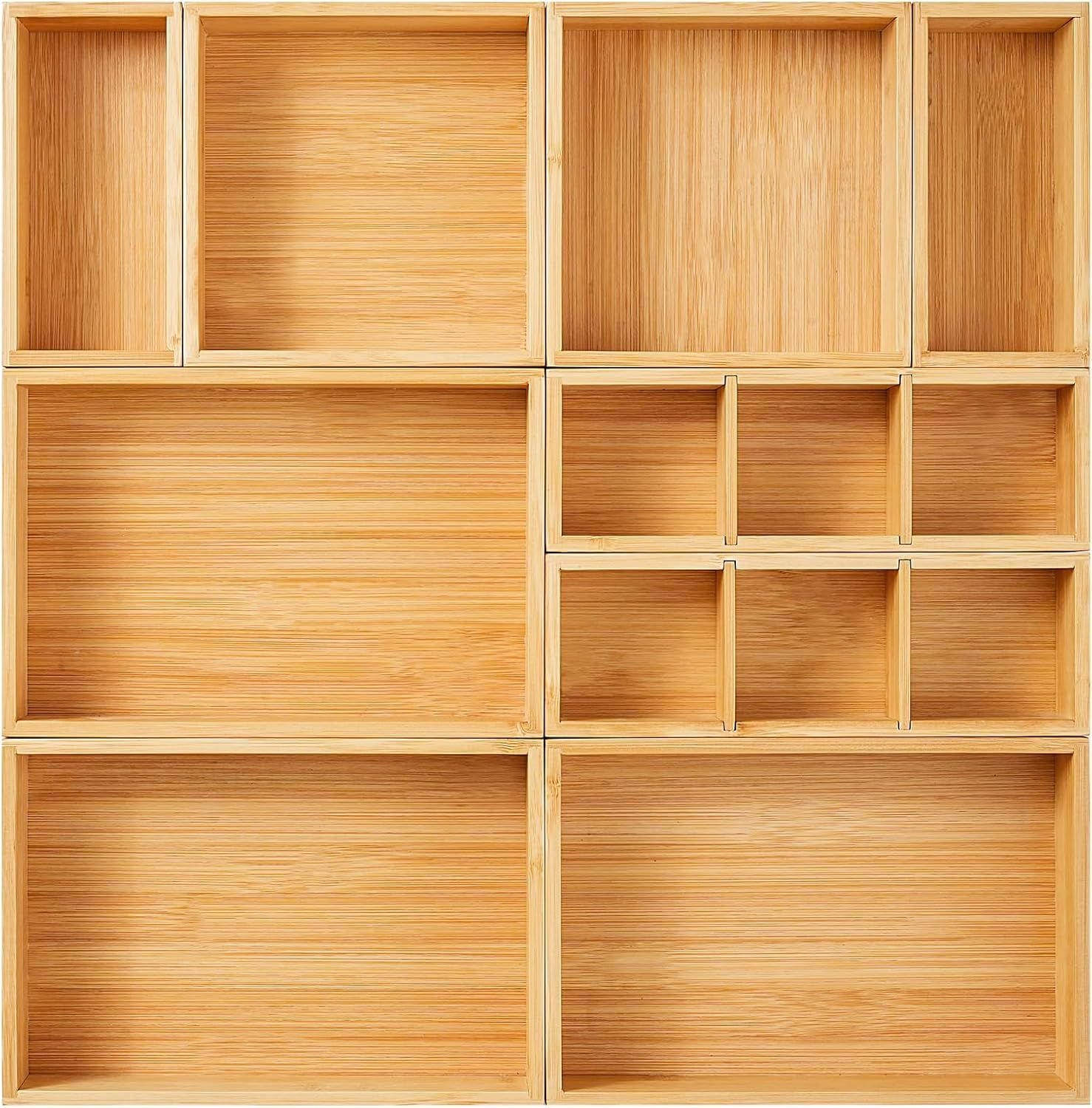
Bamboo organizers are sturdy, attractive, and naturally antimicrobial — a great choice for your cutlery drawer or anywhere you store food-related tools. They come in modular sets that you can arrange to fit your exact drawer dimensions.
Our Set of 9 Bamboo Drawer Organizer Boxes at $52.63 is perfect for this — the nine different-sized bins let you customize the layout for cutlery, utensils, or even a tea and coffee drawer.
Silicone Drawer Organizers
Silicone organizers are flexible, easy to clean, and grippy — they won't slide around in the drawer as you rummage through them. The modular design means you can combine them in different configurations to fit any drawer size.
Our 5-Pack Silicone Drawer Organizer is a great DIY-friendly option — rearrange the pieces however you like to create the perfect layout.
Expandable Cutlery Trays
For your main cutlery drawer, an expandable tray that stretches to fit the width of your drawer is ideal. Look for enough compartments to separate forks, knives, spoons, and serving utensils without mixing them together.
Our Knife and Fork Storage Box expands to fit different drawer widths and keeps everything neatly separated.
Pull-Out Cabinet Organizers
If your problem goes beyond drawers into deep, dark cabinets where things get lost in the back, a pull-out organizer is a game-changer. Instead of digging to reach items in the back of a cabinet, everything rolls forward to meet you.
Our 2-Tier Pull-Out Cabinet Organizer at $51.96 is built from heavy-duty steel and fits most standard kitchen cabinets.
Step 5: Put Everything Back Intentionally
Now the satisfying part. Put items back drawer by drawer, following your zone plan. A few tips as you go:
Stand items upright when possible. Measuring spoons, spatulas, and small tools are easier to find and grab when they're standing up in a bin rather than lying flat and overlapping.
Group like with like. All baking tools together. All grilling tools together. All cutting tools together. You shouldn't have to hunt through multiple drawers to find what you need for one task.
Leave room to breathe. Drawers that are packed to the brim get disorganized within days. Aim for about 70–80% full so there's room to access things easily without disrupting the whole layout.
Put the most-used items at the front. The back of a drawer is for things you use occasionally. Your daily spatula shouldn't be buried behind the turkey baster.
Step 6: Tackle the Junk Drawer Last
Every kitchen has one. The junk drawer is its own category and deserves its own approach.
The secret to a functional junk drawer isn't eliminating it — it's curating it. You're allowed to keep a catch-all drawer. You're just not allowed to let it become a chaos zone.
Start by removing anything that belongs somewhere else entirely (those belong in other rooms or in the trash). Then give the remaining "miscellaneous" items a home within the drawer using small bins or dividers. Batteries in one bin. Rubber bands and clips in another. Pens and notepads together.
A junk drawer with dividers is still a junk drawer — but a functional one you can actually find things in.
Maintaining an Organized Kitchen
The hardest part of kitchen organization isn't the initial setup — it's maintaining it. A few habits make all the difference:
- Put things back where they belong immediately after use. Every. Single. Time. One exception leads to two, and within a week, the drawer is chaos again.
- Do a quick monthly reset. Spend five minutes putting misplaced items back in their correct spots.
- Resist the urge to keep things "just in case." If you haven't used it in six months and it doesn't have a specific upcoming purpose, let it go.
Shop Storage & Organization at Nested Kitchen
Ready to get started? Browse our full range of drawer organizers, cabinet organizers, food storage solutions, and kitchen storage accessories.
👉 Shop Storage & Organization
👉 Shop Cabinet & Drawer Organization
👉 Shop Food Storage
